
Measurement & Diagnosis
AI Visibility Is Competitive: What 90 Days of Citation Tracking Revealed
What 90 days of AI citation data revealed about competitive visibility, question-level movement, competing sources and why absolute improvement can mislead.
AI visibility is often reduced to a score. A company appears in a certain share of answers, sits above or below a competitor, or accumulates a certain number of citations.
A single score hides most of what’s moving. Buyers ask different questions. AI systems draw on different sources. Competitors are changing at the same time, whether or not anyone is measuring them.
Over 90 days, we tracked those changes in a live, competitive luxury real estate market. What happens when AI visibility is observed as a competitive position rather than a static score?
Study at a glance: 90 days · a competitive U.S. luxury real estate market · multiple AI systems · a fixed cohort of prompts used for longitudinal comparison.
Methodology
Strategic Advantage analyzed 90 days of data collected through a leading AI prompt and citation monitoring platform for a luxury real estate client. For a defined set of commercially relevant buyer questions, we tracked whether the client was mentioned, whether the client’s website was cited as a source, which competing sources were cited, and how those patterns changed over the period.
Because several prompts were added during the 90 days, longitudinal comparisons use only the fixed cohort that was present throughout the comparison period. This prevents later additions from distorting the opening-versus-closing results.
AI Visibility Is Relative, Not Absolute
Across the stable question cohort, the client’s domain citation coverage, meaning the share of monitored answers citing its website, averaged roughly 47% during the opening comparison period and roughly 52% during the closing period. Over the same periods, the closest competing domain moved from roughly 44% to roughly 39%.
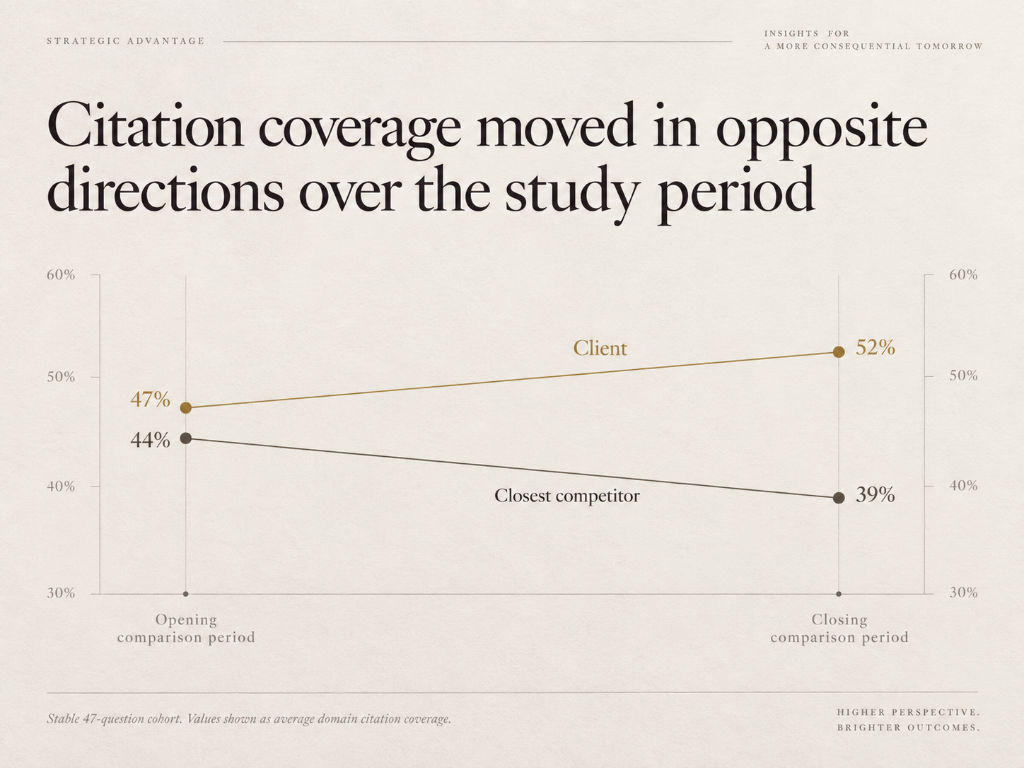
Those two lines describe different kinds of improvement. The client’s own domain citation coverage rose by about five points: an absolute improvement. Its position against the closest alternative changed by far more, because the two moved in opposite directions: a relative improvement. At the start of the period they were within a few points of each other. By the end, a real gap had opened.
The same five-point gain wouldn’t mean the same thing in every environment. If competing sources had gained faster, the client’s absolute visibility could have improved while its relative position weakened. A business isn’t improving its evidence, its content or its citation visibility in isolation. Other businesses and sources are changing too, and that competitive environment exists whether or not a business chooses to measure it.
Google’s documentation offers a useful illustration. It describes AI Mode and AI Overviews as able to run multiple related searches across subtopics and data sources, then identify supporting pages to show alongside the response, and it’s explicit that meeting every requirement doesn’t guarantee a page will be served. Google’s AI Mode announcement describes the same fan-out approach. Our interpretation is that Google’s generative search experiences still involve competitive selection among available sources. The interface has changed. The need to choose among alternative sources hasn’t gone away.
Across the full 90-day report, the client had 43% domain citation coverage, compared with 38% and 35% for the two closest competing domains. That aggregate view covers the full monitored set across the reporting period, while the opening-versus-closing comparison uses only the fixed cohort tracked throughout. They answer different questions and shouldn’t be treated as the same measurement.
Competition Happens at the Question Level
Buyers don’t ask AI systems for a visibility score. They ask about problems, trade-offs and decisions, and each question has its own set of sources in contention.
One question about year-round living improved by roughly 50 percentage points over the study period. Questions touching other practical ownership decisions also strengthened. At the same time, several broad “best agent” and general market-condition questions declined materially, some by more than 20 points.
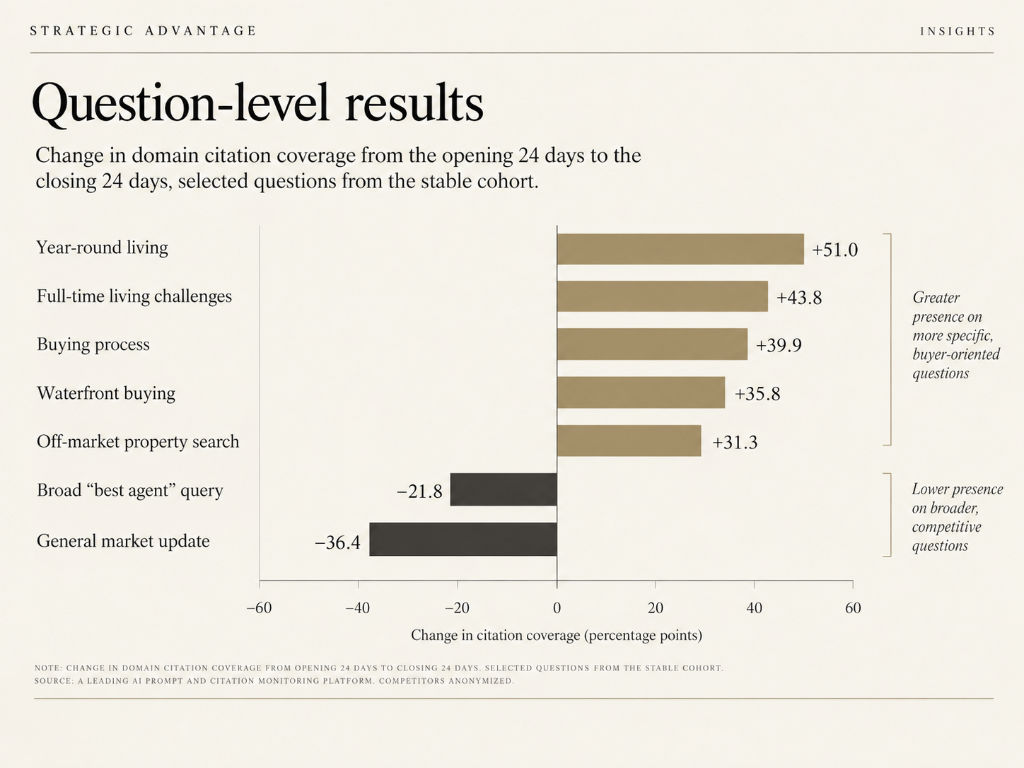
A brand doesn’t have one fixed competitive position across every question. Over the same 90 days, the client was strengthening around some buyer problems, holding steady on others and losing ground on others. Company-level visibility is an aggregation of those question-level positions, and a brand-wide score can look flat while meaningful gains and declines cancel each other out.
A weaker result on a question that matters commercially is a diagnostic signal, not just a negative number. The data doesn’t explain the cause on its own; that takes looking at the evidence behind the question, the sources being cited and what changed over the period. Only then can a finding inform whether further work is warranted.
The useful unit of competitive analysis is often the buyer question, not the brand-wide score.
Your AI Competitor May Not Be Your Business Competitor
The largest decline in the set came on a general market-update question. When we looked at who gained ground there, it wasn’t one of the established real estate competitors taking the client’s place. Two of those competitors lost ground on the same question, and the third barely moved.
The sources that gained included news and media publications, both industry and local, alongside a real estate business outside the established competitor set and a property data site. On that question, the client wasn’t only competing with other agents and brokerages. Its website was competing with other sources AI systems could use to answer the question.
Competition for AI visibility can happen at the source level as well as the business level. A company may compete commercially against one set of businesses while its website competes for citation against a much broader group of information sources, particularly on informational questions like market updates. The data shows who gained. It doesn’t show why those sources were selected, or that any one of them displaced another.
Activity Is Not the Same as Competitive Progress
Over the same period, more than 200 newly cited pages from one established competitor entered the citation environment, most of them individual listing pages. Yet its overall citation share declined.
Both things were true at once. The data does not show whether the new pages helped, harmed or had little effect on overall citation performance. It shows only that more pages entering the citation set and a stronger competitive position are different measurements. The simple assumption that more content means more citations means stronger AI visibility isn’t supported here. Getting cited and staying cited are different problems, for competitors as much as for anyone else.
Mentions and Citations Tell Different Stories
Mentions and citations are only two parts of a broader AI visibility picture, but even those two can tell different stories.
Across the full 90-day report, brand coverage was 32%, while domain citation coverage for the client’s website was 43%. The two metrics measure different forms of visibility and shouldn’t be treated as interchangeable. Brand coverage shows whether the company appears in the answer. Domain citation coverage shows whether the company’s published information appears among the sources used to support it.
Owned Content Can Become Competitive Evidence
Across the 90-day report, the client’s homepage was the second most-cited URL in the monitored environment, while a buyer-focused article ranked fifth. Together, those two pages accounted for roughly 4,100 citation instances.
A client article about year-round living first appeared in the citation data roughly a third of the way through the study. The buyer question it most directly addressed subsequently recorded one of the largest citation gains in the monitored set. That sequence doesn’t establish causation, but it’s consistent with owned information entering the source environment for a question it was specifically equipped to answer.
When owned content enters that environment, it joins a field of alternative sources already capable of answering the same question. It becomes competitive evidence within a specific information need. The data doesn’t show that publishing alone explains the pattern, or that owned content automatically displaces anything else.
Citation Tracking Becomes More Useful Over Time
A single audit shows where a business stands on the day it’s measured. It says little about direction.
The 90-day view showed what a snapshot couldn’t: that competitors were moving at different speeds, that new sources were entering the answer environment, that the client’s position was improving on some questions while weakening on others, and which of its own pages were beginning to be treated as evidence. None of that is visible from checking once.
What This Study Does Not Prove
This study doesn’t establish that individual interventions caused particular citation gains, that the same results would occur in another market, or that visibility, once gained, is permanently secured. AI systems, source availability and competitor behavior were all changing during the same period.
What the study does demonstrate is narrower: citation visibility can change materially within an active competitive environment, and those changes can be measured at the level of individual questions, domains and sources.
Visibility Is Not the Business Outcome
Over the same 90-day period, the client also increased both market share and revenue. Those outcomes were measured separately from the citation data, so this study does not establish that one caused the other.
Domain citation coverage, brand coverage and competitive visibility indicate how a business is represented within AI-generated answers. Market share and revenue measure what happened commercially. The two should be examined together over time, but they shouldn’t be treated as interchangeable evidence.
What the 90-Day Data Revealed
Being understood well enough to participate in AI answers is only the threshold. Once a business is there, its position is still relative to the alternatives available for each question being asked.
A business can improve its own representation and still lose relative ground. It can also make a modest absolute gain that becomes more significant when competing sources weaken. Its competition on one question may be a rival brokerage; on another, a news publication. So the useful question isn’t simply whether visibility improved. It’s how the business’s position changed within the information environment around the questions that matter to it.
A business doesn’t build its AI profile in a vacuum.
Questions
Frequently asked questions
Can AI visibility improve over time?
It can. In this 90-day study, a client's domain citation coverage rose across a stable set of tracked questions while its closest competitor's declined, so its relative position improved by more than its absolute gain alone would suggest. The pattern wasn't uniform across every question tracked.
What is AI citation visibility?
AI citation visibility describes the extent to which a company's website or published information is cited as a source within AI-generated answers to relevant buyer questions. This is Strategic Advantage's working terminology, not necessarily an industry-standard definition.
Are AI mentions and AI citations the same thing?
No. A mention means the company appeared in the AI-generated answer. A citation means the company's published information was used as a source. Both are only part of the broader visibility picture, and in this study the two figures differed meaningfully for the same client over the same period.
Why should AI visibility be measured against competitors?
Because AI visibility happens in a selective information environment. For a given question, many businesses and sources may be relevant, but they aren't all represented equally, and a business can improve its own visibility while losing relative position if others improve faster. In this study, the client and its closest competitor started close together and moved in opposite directions, something an absolute percentage alone wouldn't show.
Can a company's own website become a source for AI answers?
Yes, where the published information is genuinely relevant to the specific question being asked. In this study, a client's own pages ranked among the most-cited URLs across the entire monitored question set. Publishing alone does not guarantee citation; client-owned pages were cited where their subject matter directly addressed questions in the monitored set.
Does improving AI visibility mean appearing more often for every question?
No. This study's 90-day observations showed considerable variation between individual questions, with some improving substantially, some staying flat, and some declining, often at the same time.
How should companies measure AI visibility?
Competitive citation tracking is one part of it. A broader diagnosis also distinguishes recognition, understanding, inclusion, citation and recommendation, using representative questions and enough history to separate real movement from a snapshot.
Updated